Zero-Loss Liquid Hydrogen Storage and Transfer Technology Transforms the Hydrogen Economy
Read Time: 0 minutes
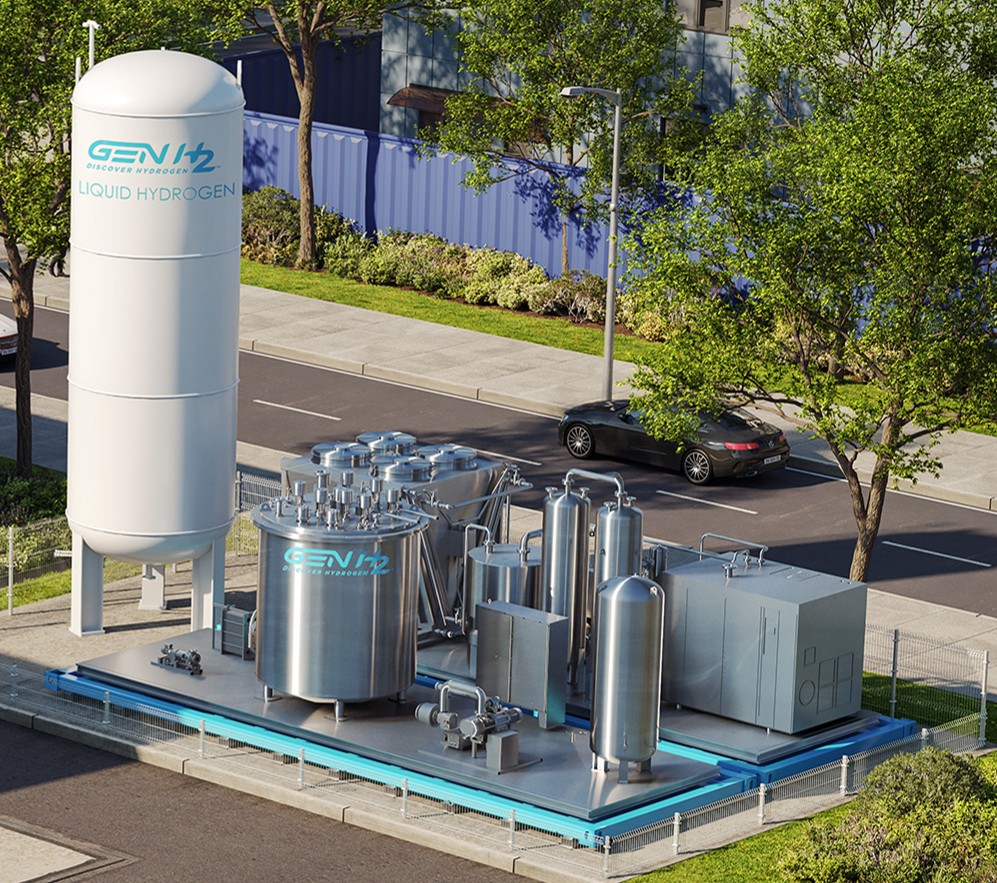
RS 1500 Controlled Storage System
Hydrogen is essential to reducing carbon emissions and transitioning away from fossil fuels. Yet storage and transfer losses of up to 40% have limited its cost-effectiveness and slowed adoption. The key to unlocking hydrogen’s potential lies in Zero-Loss Controlled Storage Technology. By minimizing loss, liquid hydrogen (LH2) can achieve its promise as a scalable alternative fuel for transportation, backup power and long-duration energy storage. Applications range from refueling infrastructure for heavy-duty trucking, mass transit, aviation, maritime and rail, to remote power systems, R&D and back-up energy storage. The most effective way to reduce storage and transfer losses is through refrigerated storage systems that are capable of keeping liquid hydrogen in an optimal state of pressure and temperature.
The LH2 Challenge
Because LH2 naturally evaporates under normal conditions, storage systems must be engineered to prevent venting of boiloff gases. Attempting to store LH2 without proper control is like trying to stop water from boiling on a hot stove.
To maintain hydrogen in its optimal liquid state, advanced zero-loss technology utilizes refrigeration to remove heat and control pressure within the bulk storage tank. These controlled storage systems can preserve LH2 indefinitely and deliver it to the end-use application when it is needed, without loss. The foundations of refrigerated storage were developed in support of the NASA space program and, building on that foundation, GenH2 has extended the technology into commercial hydrogen infrastructure products backed by numerous patents and patents pending.
Cryo Turbo Refrigeration
Liquid hydrogen storage has always been challenged by boiloff gas (BOG), where hydrogen escapes as it warms—especially during tank filling, storage and refueling. Conventional storage systems only remedy for venting during filling is to allow extremely high pressure to build in the bulk storage tank. This appears to be effective at a point in time, but because there is no way to relieve that pressure without active heat removal, the liquid hydrogen becomes saturated and the losses are magnified during transfer and dispensing.
GenH2’s controlled storage is the only technology available that utilizes active heat removal to control the temperature and pressure inside the liquid hydrogen bulk storage tank, preventing losses before they occur. Other hydrogen loss mitigation techniques involve capturing hydrogen gas after it has been vented (boiloff gas management). There is a very distinct difference between preventing loss and boiloff gas management that attempts to deal with the losses after they have occurred.
If you can’t prevent loss and can only capture vented hydrogen gas, there are a couple of options that are commonly pursued and neither one is ideal.
- One approach to boiloff gas management is to reliquefy the captured hydrogen gas and put it back in the bulk storage tank. The problem with this approach is that the amount of power needed to reliquefy hydrogen is too high to make it viable. The power requirement to reliquefy hydrogen is significantly higher than operating a controlled storage system that prevents the losses from occurring in the first place.
- Another approach involves storing the vented hydrogen in gaseous form and dispensing gas to gas. Not only does this approach require an additional storage vessel, gas compressor and more physical space (almost doubles the refueling station footprint), but it is also very energy-intensive, unreliable and requires extensive corrective maintenance.
Fuel station operators with experience storing hydrogen gas for dispensing have almost universally concluded that it is not a viable approach and have changed direction to store and dispense liquid hydrogen. Liquid hydrogen fuel station operators are becoming more aware of the significant hydrogen losses during operations and already knowing that boiloff gas management is not a workable solution, are starting to require refrigerated storage technology specifically for loss prevention vs. boiloff gas management. Following is an excerpt from a Transit District’s recent RFP for its bus refueling station:
“The loss of hydrogen has been attributed to boiloff from circulation of hydrogen back to the storage tank during refueling activities and refueling of the liquid storage tank. The loss of hydrogen has been in excess of 40%, resulting in operational costs that are not sustainable with the District’s goal of future zero emission fleet expansion. We are seeking proposals from qualified bidders to design, build and install a fully functional state-of-the-art refrigerated hydrogen storage system to substantially reduce or possibly eliminate all hydrogen losses associated with liquid hydrogen refueling.”
Breaking Barriers
By solving the boiloff problem, controlled storage removes the final obstacle to widescale LH2 adoption. Key benefits include:
- Zero Loss: Active heat removal and pressure control eliminate loss from tank filling to dispensing.
- Lower Pressure, Higher Efficiency: Reduced-pressure storage simplifies filling and eliminates venting.
- Cost Savings: Zero-loss systems boost fuel station efficiency and cost competitiveness.
- Reliability: Subcooled hydrogen lessens pump cavitation, reducing maintenance and extending equipment life.
Benefits By-the-Numbers
For hydrogen station operators, product loss is the single biggest challenge. In a typical 18,000-gallon LH2 bulk storage tank installation, venting up to 40% of the hydrogen can cost millions of dollars annually. Here’s an example of fueling station economics with hydrogen losses, with very conservative assumptions for hydrogen loss:
- Amount Dispensed: 3,000 kg/day
- Cost of Liquid Hydrogen Delivered: $8/kg
- Average Loss of Hydrogen: 25%
- Loss in Revenue: $2,184,000/year
- Cost of Electricity: $.15/kWh
Clearly, these are not numbers that are going to support growth of the hydrogen infrastructure and, until this problem is addressed, hydrogen will not be able to compete with diesel as a fuel source for mobility applications. Refrigerated controlled storage promises to do just that.
Summary of the Impact
- Compelling ROI: Recaptured losses cover system investment in under two years in most cases.
- Lower Price at the Pump: Elimination of hydrogen losses allows for more competitive pricing.
- Higher Reliability & Uptime: Protects pumps, reduces downtime, improves customer experience.
- Scalable Future-Ready Design: Modular systems grow with demand without redesign.
Adopting controlled storage is a strategic investment that eliminates significant financial losses, protects critical infrastructure and enables competitive hydrogen pricing. Deploying zero-loss LH2 storage and transfer technology is critical to the development of a practical, resilient and scalable hydrogen economy. genh2.com
Greg Gosnell
CEO of GenH2 Corp.
This is a re-post from Cryogenic Society of America.