Liquid Hydrogen Storage: Why Loss Prevention Matters
By: GenH2 Staff
Read Time: 0 minutes
This article is part of a GenH2 thought-leadership series exploring the fundamentals of liquid hydrogen storage as hydrogen infrastructure scales—from loss prevention to real-world deployment.
As demand for clean, reliable energy continues to grow, hydrogen is emerging as a critical energy carrier—especially for applications that require high power, long duration, and zero emissions. Among hydrogen’s various forms, liquid hydrogen (LH₂) stands out for its exceptional energy density. But realizing its full potential depends on solving one fundamental challenge: loss prevention.
The Promise—and the Problem—of Liquid Hydrogen
Liquid hydrogen delivers unmatched gravimetric energy density, making it well suited for large-scale energy storage and high-demand uses such as transportation, grid support, and industrial operations. Unlike batteries, which are optimized for short-duration discharge, hydrogen can store energy for extended periods and be converted back to electricity when needed.
However, LH₂ must be stored at cryogenic temperatures. Even with advanced insulation, unmanaged storage systems experience boil-off—where hydrogen warms, vaporizes, and is vented. These losses reduce usable fuel, increase operating costs, and complicate safety and logistics. At scale, they can undermine the economic and environmental value of hydrogen altogether.
Why Loss Prevention Is Critical at Scale
As hydrogen moves from demonstration projects to real infrastructure, storage efficiency becomes a defining factor. Losses that may seem manageable in small pilots grow significantly when storage volumes increase. For energy storage applications, where value is tied directly to retained energy, uncontrolled losses are not sustainable.
Effective loss prevention is not simply about better insulation—it requires active control of the storage environment.
The Role of Active Cryogenic Refrigeration
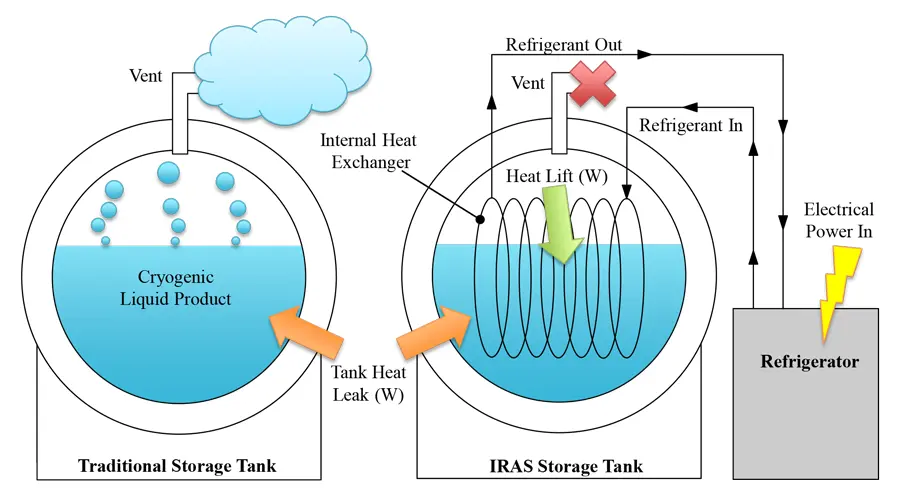 Research led by NASA and national laboratories, including the GODU-LH₂ program, demonstrated a key insight: active cryogenic refrigeration can maintain precise temperature and pressure conditions inside LH₂ tanks, preventing boil-off and eliminating the need for venting.
Rather than accepting evaporation as inevitable, controlled liquid hydrogen storage treats LH₂ as a high-value energy asset. By actively removing heat from the tank, hydrogen remains in a stable, dense, and ready-to-use state—maximizing the amount of fuel that can be stored, transferred, and ultimately used.
Enabling Hydrogen as Long-Duration Energy Storage
Loss-free liquid hydrogen storage changes what’s possible for clean energy systems. It allows excess renewable power from wind and solar to be converted into hydrogen, stored without waste, and dispatched when generation is low. In this role, LH₂ functions as a true long-duration energy storage medium—bridging the gap between intermittent supply and continuous demand.
This capability is especially important for sectors that cannot be easily electrified and for energy systems that require resilience, reliability, and scalability.
From Research to Real-World Infrastructure
The validation of active cryogenic refrigeration marks an important step in the evolution of hydrogen infrastructure. As the industry focuses on deployment and economics, storage efficiency will play a central role in determining which solutions scale successfully.
Loss prevention is not a secondary consideration—it is foundational.
Looking Ahead
Liquid hydrogen offers enormous promise as a clean energy carrier. Ensuring that stored hydrogen remains available, usable, and uncompromised is essential to unlocking that promise. As hydrogen systems grow larger and more integrated into energy infrastructure, controlled LH₂ storage will be a key enabler of practical, efficient, and reliable clean energy.
At scale, the future of hydrogen depends not just on producing clean fuel—but on keeping it.
To learn more, download our Controlled Storage eBook.
About this series: GenH2 advances liquid hydrogen infrastructure by contributing engineering insights and industry perspectives. This series is intended to support informed discussion around hydrogen storage challenges and opportunities as the energy transition accelerates.