Why Hydrogen—And Why Now—for Public Transit?
By: GenH2 Staff
Read Time: 3 minutes
Transit agencies across the U.S. and globally are facing a defining moment. The push toward zero-emission transportation is accelerating, driven by climate commitments, regulatory mandates, and growing public demand for cleaner air. At the same time, agencies must maintain reliable, cost-effective service across increasingly complex and demanding routes.
This is where hydrogen—particularly fuel cell technology—is gaining momentum.
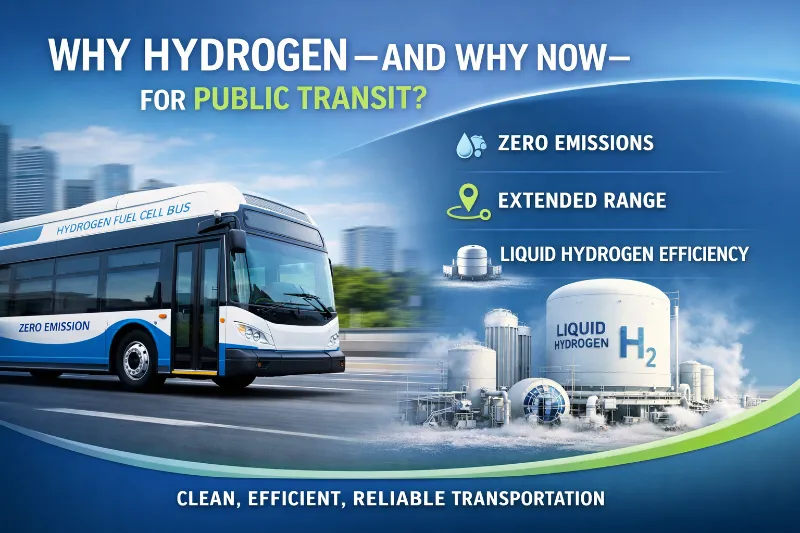
Hydrogen fuel cell buses produce zero tailpipe emissions, emitting only water vapor and heat. This makes them a powerful solution for improving air quality in densely populated urban corridors, where transit systems operate at scale, and emissions have an outsized impact. As transportation remains one of the largest contributors to greenhouse gas emissions, transitioning bus fleets to zero-emission alternatives is no longer optional—it is essential.
But not all zero-emission solutions are created equal.
Battery-electric buses have made meaningful progress, especially for shorter routes and lower-duty cycles. However, many transit agencies are discovering that hydrogen fuel cell buses offer distinct advantages for heavy-duty, high-utilization operations. These include longer range, faster refueling, and the ability to maintain existing service schedules without significant operational disruption.
In real-world deployments, hydrogen is already proving its value.
California-based transit agencies have been early adopters, demonstrating both the viability and scalability of hydrogen-powered fleets. Agencies such as AC Transit and Golden Empire Transit District have successfully integrated hydrogen fuel cell buses into daily operations, collectively logging millions of miles while reducing emissions and maintaining service reliability. These deployments underscore a critical point: hydrogen is no longer an emerging concept—it is a working, scalable solution.
Equally important is hydrogen’s flexibility as an energy carrier. It can be produced from a variety of domestic resources, including renewable sources such as solar and wind. This positions hydrogen not only as a transportation fuel but as a key enabler of broader energy resilience and decarbonization strategies.
As hydrogen adoption grows, attention is increasingly turning to how hydrogen is stored, handled, and delivered—especially at scale.
This is where liquid hydrogen for public transit begins to play a critical role. By increasing energy density and enabling more efficient storage and transport, liquid hydrogen can help transit agencies reduce fuel losses, improve operational efficiency, and better support expanding fleets. Emerging innovations in controlled storage and transfer technologies are further addressing long-standing challenges such as boil-off and system inefficiencies—helping ensure that more of the hydrogen produced is ultimately used for mobility.
For transit agencies, the question is no longer whether to transition to zero-emission fleets—but how to do so effectively.
Hydrogen offers a pathway that aligns environmental goals with operational realities. It enables agencies to decarbonize without compromising range, uptime, or rider experience—critical factors in maintaining public trust and system performance.
As the industry continues to evolve, hydrogen—and increasingly, liquid hydrogen—will play a central role in shaping the future of clean, reliable public transit.
To learn more about how GenH2 is revolutionizing the bus transit industry, click here.