Hydrogen Economy: Infrastructure & Education
Read Time: 4 minutes
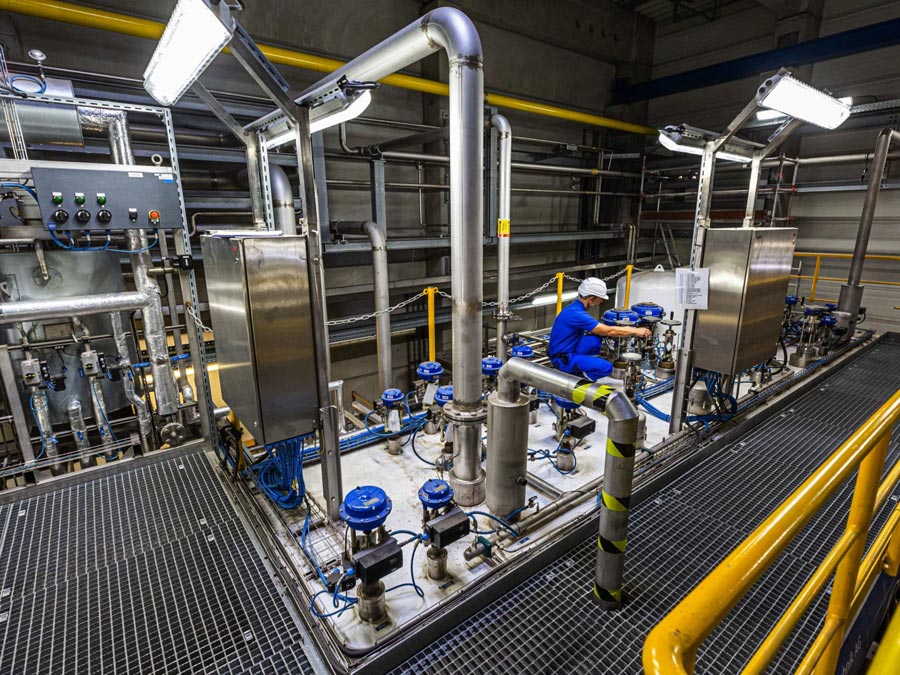
An employee adjusts a valve on the cold box for liquid hydrogen (LH2) production. Photo: Bloomberg.
June 12, 2022
The Hydrogen Economy Goes Nowhere Without Infrastructure And Education
Among emerging green energy sources, hydrogen is enjoying the spotlight. What’s missing, however, is the discussion of two essential elements: infrastructure and education. Without both, the wide-scale adoption of any new energy technology will go nowhere.
With the support of the U.S. Department of Energy (DOE), liquid hydrogen technology is moving steadily from the drawing board to real-world deployment and industry is stepping up. Still, more needs to be done by both the public and private sectors.
First, the good news. Within three years, hydrogen filling stations will start to appear all across America, not just in California where several are currently located. In the long term, the hydrogen economy will be insulated from the kind of upheaval presently seen in global reliance on oil. Presently, most hydrogen is produced through methane reforming, which utilizes natural gas, but there are advances in new green technology that do not use petroleum-based oil or gas. New advances in electrolysis can produce clean, green energy from solar and wind farms as well as nuclear reactors, as noted by DOE leadership.
And more good news. A DOE-funded consortium of public, private and academic experts, led by Shell International Exploration and Production, Inc., is pioneering an ambitious path forward to enable large-scale liquid hydrogen (LH2) storage for international trade applications. Shell and the consortium partners — including GenH2, McDermott’s CB&I Storage Solutions, NASA’s Kennedy Space Center and the University of Houston — have been selected by the DOE Hydrogen and Fuel Cell Technologies Office to demonstrate that a large-scale LH2 tank, with a capacity ranging from 20,000 to 100,000 cubic meters, is both feasible and cost competitive at import and export terminals.
However, despite all of the buzz surrounding hydrogen, there is a lack of education specifically about the significant role it will play in the near future. Raising the knowledge at a local level will be critical in unlocking hydrogen’s potential. The science says that liquid hydrogen in 2022 can be significantly safer than even gasoline or diesel, yet many local governments are still hesitant to add stations because of incorrect public perceptions rooted in gaseous hydrogen circa 1937. As an industry, the corporate energy sector is embarking on programs to further educate people throughout North America on the facts about liquid hydrogen fuel. Federal, state and local governments should be embarking on the same mission.
On the infrastructure side, industry is hopeful that easier government permitting will support the vital need to roll out hydrogen infrastructure to create a sustainable ecosystem in the U.S. More needs to be done to support the rollout of these stations, including broad federal permitting for the stations, because not every station will be the same. For example: there are different sizes and multiple shapes; some are micro-stations that are only capable of filling up four to five cars per day; while other stations can be extremely large, especially at truck stops.
Similarly, private industry is focusing on the mass production of components required for liquid hydrogen filling stations and their current lack in the market. Unfortunately, it is not possible to simultaneously roll out 300 stations if there are only 20 or 30 parts available at any one time. More incentives at the state and local level will encourage the creation of manufacturing sites to get to scale. At this moment in the U.S., California is the only state offering significant incentives. Creating a federal program would put nationwide power behind energy alternatives, including hydrogen.
In my opinion, education and infrastructure are critical to ensuring feasible alternative energy sources like liquid hydrogen moving steadily toward a carbon neutral future. Otherwise, the road ahead will lead right back to continued reliance on fossil fuels.
This is a re-post from SupplyChainBrain.