Hydrogen Myth vs. Reality: Are Hydrogen Fuel and Stations Really Too Expensive?
By: GenH2 Staff
Read Time: 0 minutes
As hydrogen adoption expands across transportation, power generation, industrial processes, and energy storage, one myth continues to surface:
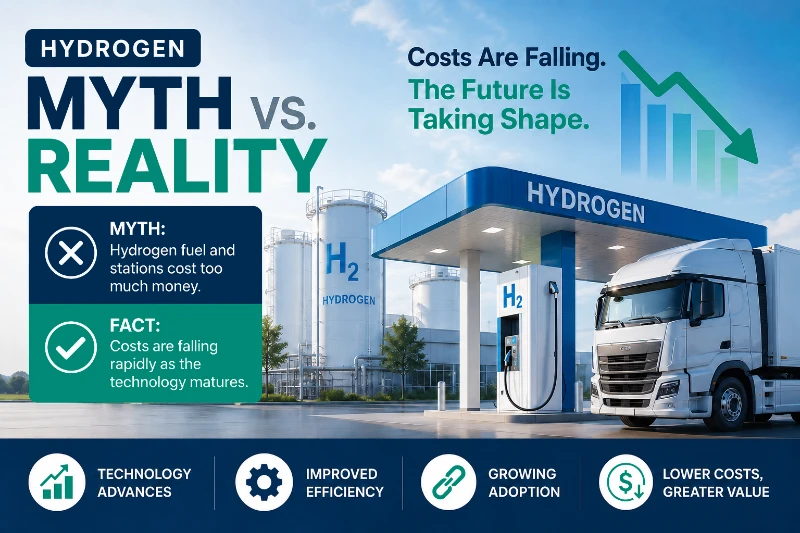
❌ Myth: Hydrogen fuel and fueling stations cost too much money.
✅ Fact: Costs are falling rapidly as the technology matures.
As part of our Hydrogen Myth vs. Reality series, inspired by common misconceptions highlighted by the Hydrogen Fuel Cell Partnership, we’re taking a deeper look at what these topics mean for real-world hydrogen infrastructure and commercial deployment.
While cost concerns may have been valid during the earliest stages of hydrogen deployment, the reality today tells a very different story.
Hydrogen technologies are advancing rapidly, infrastructure is expanding, and innovations across production, storage, transportation, and fueling are helping improve economics throughout the value chain.
Why Early Hydrogen Costs Were Higher
Like any emerging industry, hydrogen infrastructure requires significant upfront investment.
Early projects often involved:
- Limited production capacity
- Small fueling networks
- Custom-engineered equipment
- Low manufacturing volumes
- Limited operational experience
- Developing supply chains
With relatively few installations and limited commercialization in the early days, costs were naturally higher than they are today.
However, focusing solely on early deployment costs overlooks the significant progress the industry has made.
Industry Growth Is Driving Costs Down
Hydrogen technologies are becoming more efficient, more standardized, and easier to deploy.
Several factors are contributing to lower costs across the hydrogen value chain:
Technology Improvements
Advances in production, liquefaction, storage, transfer, and fueling technologies continue to improve performance while reducing operational costs.
Manufacturing and Deployment Experience
As hydrogen projects move from demonstration programs to commercial deployment, manufacturers and operators gain valuable experience that improves efficiency, reduces complexity, and lowers costs.
Supply Chain Development
As more organizations enter the hydrogen market, supply chains become stronger, more competitive, and better equipped to support growing demand.
Expanding Market Adoption
Growing use of hydrogen across transportation, industrial applications, power generation, aviation, shipping, and energy storage creates opportunities for continued innovation and cost reductions throughout the industry.
Infrastructure Costs Must Be Viewed Long-Term
One common mistake is evaluating hydrogen infrastructure solely through the lens of upfront capital costs.
The more important question is:
What value does the infrastructure provide over its operating lifetime?
Hydrogen infrastructure can support:
- Commercial vehicle fleets
- Transit systems
- Heavy-duty trucking
- Rail applications
- Airports and ports
- Industrial facilities
- Backup power systems
- Energy resilience initiatives
As utilization increases, infrastructure investments can deliver greater value over time while supporting operational and sustainability objectives.
This is particularly important for applications where batteries may face challenges related to range, refueling time, payload impacts, or continuous operation requirements.
While production costs often receive the most attention, operators ultimately pay for the efficiency of the entire hydrogen value chain—from production and transportation to storage, transfer, and fueling.
Reducing Hydrogen Losses Improves Infrastructure Economics
When discussing the cost of hydrogen fuel and fueling infrastructure, it’s important to look beyond production costs alone.
How hydrogen is stored, transferred, and delivered can significantly impact overall project economics.
Every kilogram of hydrogen lost during storage, transfer, or fueling represents lost product and lost value.
That’s why advancements in liquid hydrogen storage and transfer technologies are becoming increasingly important. By reducing losses and improving operational efficiency, operators can maximize the value of every kilogram produced, transported, and dispensed.
Benefits include:
- Improved fuel utilization
- Reduced product losses
- Greater operational efficiency
- Lower lifecycle costs
- Better return on infrastructure investments
Innovations such as zero-loss storage and transfer systems are helping address one of the industry’s historical challenges while improving the economics of hydrogen infrastructure deployment.
As the industry grows, reducing hydrogen losses won’t simply improve efficiency—it will play an important role in making hydrogen infrastructure more cost-effective and commercially viable.
The Bigger Picture: Cost Is Only Part of the Equation
Organizations evaluating hydrogen solutions are increasingly considering more than just initial project costs.
They are also evaluating:
- Energy security
- Emissions reduction goals
- Operational flexibility
- Long-term fuel availability
- Infrastructure resilience
- Future scalability
As investment and commercial demand continue to accelerate globally, hydrogen infrastructure is moving beyond pilot projects and into broader deployment.
Reality Check: Hydrogen Is Following a Familiar Path
History shows that transformative energy technologies become more affordable as markets mature.
Solar power, wind energy, batteries, and electric vehicles all experienced significant cost reductions as technologies improved, supply chains developed, and adoption increased. Hydrogen is following a similar trajectory.
The industry is benefiting from technological innovation, expanding infrastructure, growing expertise, and increasing demand—all factors that help drive costs downward over time.
The question is no longer whether hydrogen costs will decrease.
The question is how quickly organizations can position themselves to benefit from the opportunities created as hydrogen adoption expands.
Bottom Line
Hydrogen fuel and fueling stations are not becoming more expensive—they are becoming more efficient, more capable, and increasingly cost-competitive.
As the hydrogen economy grows, continued innovation and deployment are helping reduce costs while creating the infrastructure needed to support the next generation of transportation, industrial, and energy applications.
Organizations that understand these trends today will be better positioned to capitalize on hydrogen’s growing role in the global energy landscape.
Additional Resource
The Hydrogen Fuel Cell Partnership provides helpful resources addressing common hydrogen myths and facts. Explore their materials to learn more about the role hydrogen can play in transportation, energy, and industrial applications.