Hydrogen for Transit Agencies: Fast Refueling Enables Operational Continuity
By: GenH2 Staff
Read Time: 0 minutes
For transit agencies, reliability is everything.
Buses must stay on schedule, maintain consistent service throughout the day, and maximize uptime across demanding routes and operating conditions. As agencies transition to zero-emission fleets, one operational reality is becoming increasingly clear: vehicle technology alone is not enough. Refueling and charging strategies can significantly impact service continuity, fleet size, infrastructure costs, and overall operational efficiency.
This is where hydrogen fuel cell buses are creating a meaningful advantage.
While battery-electric buses continue to play an important role in clean transportation, many transit agencies face operational challenges related to charging downtime and infrastructure limitations. Hydrogen changes that equation by enabling fast refueling and operational flexibility that closely mirrors traditional diesel fleet operations—without the emissions.
Fast Refueling Keeps Fleets Moving
One of the biggest operational advantages of hydrogen fuel cell buses is refueling speed.
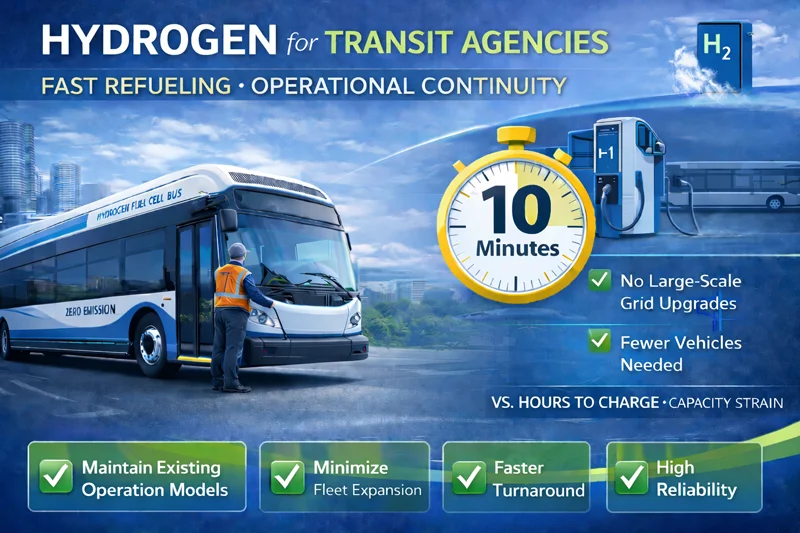
Hydrogen buses can typically refuel in about 10 minutes, comparable to conventional diesel refueling. In contrast, battery-electric buses may require several hours to fully recharge, depending on battery size, charger capacity, and fleet demand.
For transit agencies operating continuous daily schedules, this difference matters.
Fast refueling enables:
- More time in active service
- Reduced vehicle downtime
- Greater route flexibility
- Faster turnaround between shifts
Rather than building schedules around lengthy charging windows, agencies can maintain the operational cadence they already understand and rely on.
Reducing Pressure on Fleet Size and Infrastructure
Charging downtime can create ripple effects throughout an entire transit system.
Long charging windows may require agencies to:
- Purchase additional buses to maintain route coverage
- Expand depot charging infrastructure
- Reconfigure schedules and dispatch operations
- Allocate more physical space for charging equipment
These adjustments can increase both capital expenditure and operational complexity.
Hydrogen fuel cell fleets help reduce many of these pressures.
Because buses can refuel quickly and return to service faster, agencies may be able to:
- Minimize fleet expansion requirements
- Maintain existing depot operations
- Simplify scheduling and vehicle rotations
- Avoid some large-scale electrical infrastructure upgrades
For agencies balancing decarbonization goals with budget realities, these operational efficiencies can significantly influence long-term planning.
Operational Continuity Matters in Real-World Transit
Not every transit system operates under the same conditions.
Hydrogen is particularly attractive for agencies where:
- Routes regularly exceed battery range
- Continuous operation is critical
- Depot space is constrained
- Extreme temperatures impact battery performance
- High passenger demand requires maximum uptime
These conditions are increasingly common in large urban systems, regional transit operations, airport shuttles, and high-utilization bus networks.
In these environments, maintaining service continuity is just as important as reducing emissions.
Supporting Diesel-Like Operations—Without the Emissions
For many transit planners, the appeal of hydrogen lies in its familiarity from an operational standpoint.
Hydrogen fuel cell buses support:
- Long daily operating windows
- Fast fueling cycles
- High route flexibility
- Scalable fleet deployment
In other words, hydrogen enables agencies to transition to zero-emission transportation while preserving many of the operational advantages traditionally associated with diesel fleets.
That continuity can help simplify adoption, reduce disruption, and accelerate the path to broader fleet decarbonization.
The Infrastructure Conversation Is Evolving
As hydrogen adoption grows, attention is increasingly shifting from the vehicle itself to fueling infrastructure performance.
Fast refueling depends on efficient hydrogen storage, transfer, and delivery systems, especially as fleets scale. Advanced liquid hydrogen technologies are improving fueling consistency, reducing inefficiencies, and supporting higher-throughput transit operations.
Innovations in controlled liquid hydrogen storage are also helping address challenges such as boil-off and fuel losses, thereby improving the overall efficiency and reliability of hydrogen fueling ecosystems.
As transit agencies look to expand hydrogen deployments, infrastructure optimization will become a critical part of operational success.
Zero Emissions Without Operational Compromise
Transit agencies should not have to choose between sustainability and reliability.
Hydrogen fuel cell technology offers a pathway to achieve both:
- Zero tailpipe emissions
- Fast refueling
- High uptime
- Operational flexibility
- Scalable fleet performance
As the transition to clean transportation accelerates, hydrogen is proving that zero-emission transit can still operate at the speed, reliability, and continuity agencies depend on every day.