Liquid Hydrogen for Transit Agencies: Maximizing Efficiency and Range
By: GenH2 Staff
Read Time: 3 minutes
As transit agencies accelerate their transition to zero-emission fleets, the conversation is evolving. It’s no longer just about whether to adopt hydrogen—it’s about how to deploy it in the most efficient, scalable way possible.
That’s where liquid hydrogen (LH₂) is gaining attention.
While compressed hydrogen gas has enabled early adoption, liquid hydrogen offers a critical advantage: significantly higher energy density. For transit agencies, this translates directly into improved performance, operational efficiency, and long-term scalability.
More Energy Onboard—Without Compromise
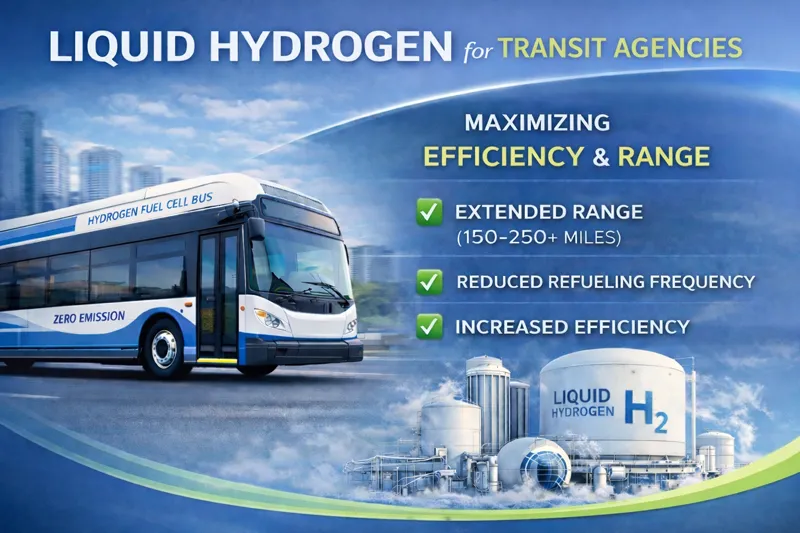
Hydrogen fuel cell buses are already capable of delivering impressive range, typically 150–250+ miles per fill under real-world operating conditions. This makes them well-suited for demanding transit routes where battery-electric solutions may struggle to keep pace.
Liquid hydrogen takes this capability further.
By storing hydrogen in a liquid state, agencies can carry more usable energy onboard without increasing tank size or vehicle footprint. This is particularly valuable for:
- Long-distance or intercity routes
- High-frequency service with minimal downtime
- Systems with extended daily run times
The result is a bus fleet that can operate longer with fewer interruptions—without compromising passenger capacity or vehicle design.
Fewer Refuels, More Time in Service
Efficiency in transit operations is measured in uptime.
Because liquid hydrogen enables higher onboard fuel capacity, buses require fewer refueling events over the course of a day or week. This creates a ripple effect across operations:
- Reduced downtime for refueling
- Simplified scheduling and dispatch
- Increased fleet utilization
For agencies managing large fleets, even small reductions in refueling frequency can translate into meaningful cost and efficiency gains.
Liquid Hydrogen – Optimized Space and Weight
Energy storage always comes with trade-offs—but liquid hydrogen helps minimize them.
Compared to large battery systems, hydrogen fuel cell platforms offer a lighter-weight solution with greater energy density. This allows for:
- More available space for passengers
- Reduced vehicle weight, which can improve efficiency
- Greater flexibility in vehicle design and integration
For transit agencies, this means zero-emission buses that don’t require sacrificing capacity or performance.
Efficiency Beyond the Vehicle
The advantages of liquid hydrogen extend beyond the bus itself.
Fuel cell systems are inherently efficient, converting hydrogen into electricity at rates that can be 2–3 times more efficient than traditional combustion engines. When combined with liquid hydrogen’s ability to store and deliver fuel more effectively, the result is a more optimized, end-to-end energy system.
As agencies scale their hydrogen programs, these system-level efficiencies become increasingly important, impacting everything from fuel logistics to total cost of ownership.
The Next Step: Managing Hydrogen More Effectively
As hydrogen adoption grows, so does the importance of how hydrogen is stored, transferred, and maintained across the fueling ecosystem.
Liquid hydrogen introduces new opportunities—but also requires advanced approaches to fully realize efficiency. Innovations in controlled storage and transfer are helping address historical challenges such as boil-off and fuel loss, enabling agencies to capture more of the energy they produce and deliver.
This is where infrastructure strategy becomes just as important as vehicle selection—and where advanced liquid hydrogen solutions are beginning to differentiate long-term success.
Doing More with Less
For transit agencies, the path to zero emissions must also be a path to operational excellence.
Liquid hydrogen enables exactly that:
- Greater range to support demanding routes
- Greater uptime through reduced refueling
- Greater efficiency across the entire system
As fleets grow and expectations rise, LH₂ provides a scalable foundation for the next generation of clean transit.
The shift to hydrogen is already underway. The shift to liquid hydrogen will help agencies maximize their potential.